ehowton: (Computer)

Not wanting to go through yet another failed marriage I've been really placing this relationship under a microscope. Yes, lessons learned from my past, but now with the wisdom to apply myself appropriately to the equation; highlighting things at which I've failed in the past - my shortcomings and how they'd work in this dynamic. I know my strengths and my weaknesses, but acknowledging one's weaknesses without actively trying to change them is akin to relationship suicide, and both parties absolutely must be present in order for any relationship to thrive. Am I stepping out of my comfort zone? Of course. And it saddens me how many people choose to conflate that action with not living authentically - that stepping out from my comfort zone is somehow not being true to myself, and portends eventual unhappiness. Forgetting of course that growth only ever occurs outside our comfort zone. Its less that I'm changing myself for the one I wish to be with, and more caring for her, myself, and the relationship enough I'm willing to put myself through an (often) uncomfortable growth cycle for the benefit of all. I just don't understand why no one else understands that. I wasn't happy, so doing the same thing over and over within a different relationship isn't the answer. The answer is to change myself; my perspectives, and embrace what I uncover through introspection and self-reflection. Being honest with oneself is exceedingly difficult because we can easily succumb to some degree of self-deception unconsciously which skews the results. That's why I'm putting in all this overtime with the existential data mining.

From my 2017 blog Do What?

I've been meaning to post about marriage for some time now. Mostly because I am inundated with memes outlining (often quite different) individualized views on the subject. Which is awesome if everyone happened to subscribe to the very specific expectation each meme imparts. More often than not however, they do not appear to be declarations of how one chooses to live their own life, rather indictments on how other's choose to live theirs. I cannot imagine, given the numerous, highly personalized perspectives on the ideal marriage, and taking into account the culturally diverse mix of heterosexuals, homosexuals, bisexuals, asexuals, Christians, Catholics, Muslims, Mormons, atheists, Hindus, Buddhists, agnostics who all run the entire spectrum of liberal, conservative, blue collar, white collar, narrative conflict (man versus man, man versus nature, man versus himself, man versus society), and wildly different reasons for choosing to (or choosing not to) marry for race, color, previous condition of servitude, cultural familial commitment, as a beard, for citizenship, loneliness, boredom, social standing, love, or to populate the world with spirit babies), that any one of those would magically fit a single, individualized expectation. Nor should it. Put that way, those silly memes do suddenly seem awfully unreasonable, don't they?

I'm currently at peace with myself, and all which surrounds me. That's the good news. Before things go any further (and they may), I needed to honestly answer why I am so adamant in pursuing her, and how far I was willing to go. To that end, the reason seemed to be, "purpose." I've waxed poetic here numerous times about contributing to something greater than yourself - which is how I see relationships - but it wasn't until this morning I settled on purpose as the reason.

Geekfriend: "I'm not following. You're feeling you have no purpose if you're not pursuing a relationship then?"

Me: "Not exactly. Simply that a relationship would give me a purpose I otherwise would not have."

Which comes back to what it is we value. I value relationships and everything they encompass and allow for. If one of my highest priorities in life is to practice intimacy, I cannot do that alone. Finding the right partner however, is not only paramount, but in exceedingly short supply. Not everyone has the same value-system as I, nor should they. I simply want to spend my time with someone who does.

Later, I rested, and continued Chapter Two in Moving Through Grief and came upon this gem which reinforced what I'd come up with on my own earlier in the day:

After we get dumped, we may immediately start dating again, without taking time to analyze what went wrong in the relationship or whether it was even aligned with our key values ... If you doubt a particular action, ask yourself, "is this action aligned with my values?" ... If the action does seem to appear to be aligned with your values, you can move forward with clarity and confidence.

In conclusion, I wasn't necessarily seeking purpose, but in her, I found it.
◾ Tags:
ehowton: (Default)


Originally posted by [livejournal.com profile] pro_ts_tumblr at the-barricades-shall-rise:

thelogicofstupid:

Playing that race...


the-barricades-shall-rise:


thelogicofstupid:


Playing that race card…


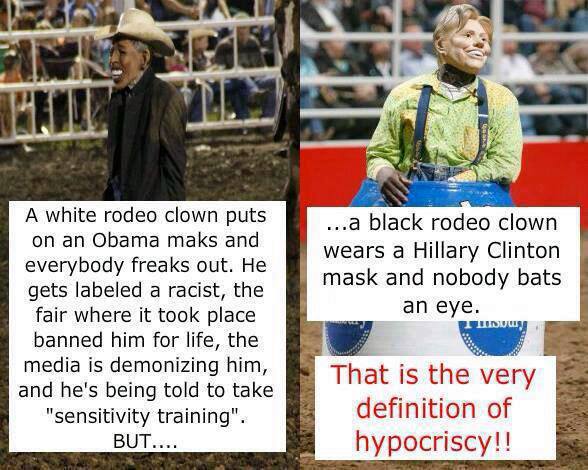
It is perplexing to me, how liberals can be so blind to hypocrisies such as this.


[livejournal.com profile] ehowton says:

While it would be hypocritical to state hypocrisy "such as this" outweighs the hypocrisy of this very image, which as far as I can tell from a little "elementary-level fact-checking" the difference was the Obama-clown's inappropriate comments rather than the inclusion of the mask - something presumably missing from the Bush-clown (as it appears to have been only an effigy) and Black-clown-wears-Hilary-Clinton-mask...clown - I wouldn't know as I wasn't at any of the depicted events. But if factual, might suggest two camps of hypocrites philosophically debating which of them was more hypocritical than the other - as if it were actually significant (its not).

But I don't care about the obvious. This rubber President mask thing reminded me of the recent outcry over ET's Julianne Hough dressing as her favorite Orange is the new Black character for Halloween (which some found offensive) or the promo shots for Nick Cannon's new release, "White People Party Music" (which others found offensive). Reading through the droves of comments on the respective stories were eye-opening; patterns emerged. What I found particularly interesting (not perplexing) was the diversity in the offense taken:

Some were offended by one and not the other, others were offended by both, and some were offended by neither - and everyone was offended (or not offended) for different reasons to the degree that people who were offended were making some of the same arguments as those who were not, and those who weren't offended were not offended for some of the reasons those who were, were. Others on both sides cited completely independent reasons from others who were also either, or not, offended.

Schism began breaking out in the camps of those who were offended if they were perceived as being offended for the wrong reason - because being offended wasn't universal enough - and those who were grouped together as having not been offended were also called out for not being offended for the right reasons. Toward the end, those who were offended for the same reasons as those who weren't were trying to convince them they ought to be while simultaneously shunning those who were likewise offended but for the wrong reason, while those who were not offended were cajoling those who were but for reasons they shouldn't to their side all the while suggesting some of those who also were not offended probably should be.

(Don't think that wasn't tricky to write.)

Just because someone has a different opinion doesn't necessarily make them wrong, but opinions based upon ignorance denotes the very word. Regardless, almost everyone who gets offended has an opinion as to why their offense is justified - wrong or not. But why tell people you're offended?

"That offends me."

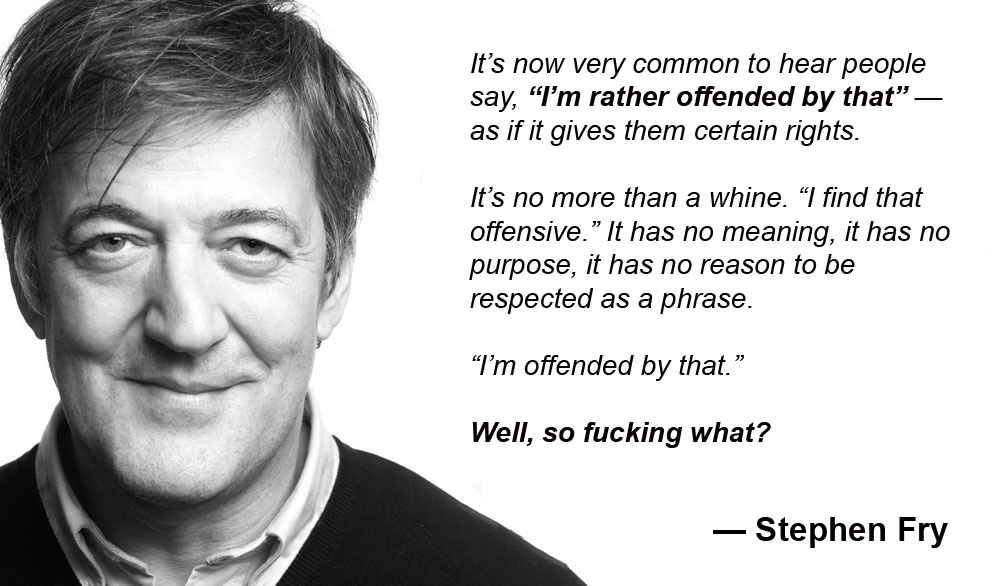
Stephen Fry is credited with the best response to date, "So fucking what?" which is admittedly always hysterical - until it happens to us - then its Issac Hayes v. Southpark all over again - suddenly and inexplicably not funny! So why tell anyone? Why admit to it?

More pointedly, what would I gain by admitting to someone I was offended? Good question, really - and I would love to dig into that question with someone who isn't me someday. My point was going to be something along the lines of never giving anyone else power over my emotions in such a way I could be manipulated - any argument to the contrary would still end with handing my emotional control over to someone else (fantastic in loving, secure relationships; not so healthy anytime else). So that's something I wouldn't do, right? Admit offense?

The question was meant to be rhetorical, but as soon as I penned it, I wondered if anyone would try to answer it - to justify themselves. I began formulating answers in a myriad of different perspectives; with most of you I've had these life-altering conversations with and we're all very different people and its all so fascinating - then suddenly, it popped out at me - the different answers I had written throughout synthesized into a single underlying reason - while each answer was seemingly diverse and varied from the next, they all contained a single motivating factor driving them: Purpose.

Since we define ourselves by what we believe (and existential questions are scary), suppressing offense calls into question our commitment to those immutable, ironclad beliefs - and we are therefore compelled to validate them to those who have trod upon them, else our very purpose in life becomes suspect.

Truth be damned.


◾ Tags:
ehowton: (Default)

Much of the personal growth rhetoric concludes with the highlight, "contributing to something greater than yourself" and often provides examples limited to volunteerism or helping others. This is one I have struggled with for some time. Admittedly, I limit my "giving" to generous monetary tips - just about everything else denigrates into a racket, even tithes were I so possessed given the overwhelming supporting evidence of televangelism - but much like the Father, the Son and the Holy Spirit, I see giving, belonging, and contributing as a trinity of mythological beasts; a hypostasis of distinct yet one - the latter of which I now believe being wholly inclusive of, while simultaneously superseding, the former two.

To contribute to something [greater than yourself] is going to require giving more than just time, money or ineffective membership. More than satisfying the instinctual sociological desire to belong - the raw visceral appeal of political parties, organized religion, sports affiliation or violent gang membership - contributing is much more of an investment, requiring an almost sacrifice of self, a rebirth or self-starting intrinsic motivation. We're all familiar with working harder at doing better on projects which interest us - a gazillion job satisfaction surveys tell us so. Think then of that level of contribution to something greater than yourself as a life project, something which pays us back far more than we could ever put in it through simple vocal or monetary alignment. Something which pays us back in unwavering, universal happiness.

To what then, do those who eschew such dichotomous associations vis-à-vis the Two-Party Swindle seek out to contribute? This is what has plagued me. Until I found the answer in the most unsuspecting of places - my past. Looking back, while almost always marred by our own idealized projections, can still provide a unique comparison to our present selves. A veritable built-in time machine function which, if utilized with the understanding that our filters will likely misinterpret the results (The Blindfold and the Chestnuts), can be used to give us a fairly accurate glimpse into one possible future.

As an empiricism junkie, I was authoring a carefully constructed piece detailing flaws in a broad assumption which I admitted I would have made myself had I not experienced it first hand. In trying to be as correct as possible in debunking some very specific (and awkwardly erroneous myths), I settled upon anecdotal troubleshooting.

[Having assumed a position] every problem I encountered proved an exciting challenge to overcome; deep philosophical issues that could touch on every aspect of societal existence. Most people complain about the same three things THEIR ENTIRE LIFE: time, money, and sex. Finding the opportunity to be faced with so much more and joyfully accepting the challenge gave purpose to my life. I wonder how many of my doe-eyed neighbors feel their life is full of purpose? Maybe they each have a story about it happening once. I found myself having created a life-purpose generator which was running full-tilt all day, every day. Life wasn't just very, very exciting - it had purpose.

A fascinating aspect of that experience was how little I focused on time, money, or sex as anything disquieting - the bane of existence for most fell to the wayside. I'm now fairly convinced only those without purpose use those three things as their focus. Hence so much unhappiness in the world.

Contributing to the purpose-filled life may very well be the apex of self-actualization, and I'm the amateur who got a peek behind the curtain. There is a world of difference between "impossible" and "hard to imagine." The first is about it while the second spotlights our own limitation.

For all others, I hear yoga is nice.

January 2026

S M T W T F S
     123
45 678910
11121314151617
18192021222324
25262728293031

Most Popular Tags

Expand Cut Tags

No cut tags